Tag Archives: green

Air Quality in Gillygate

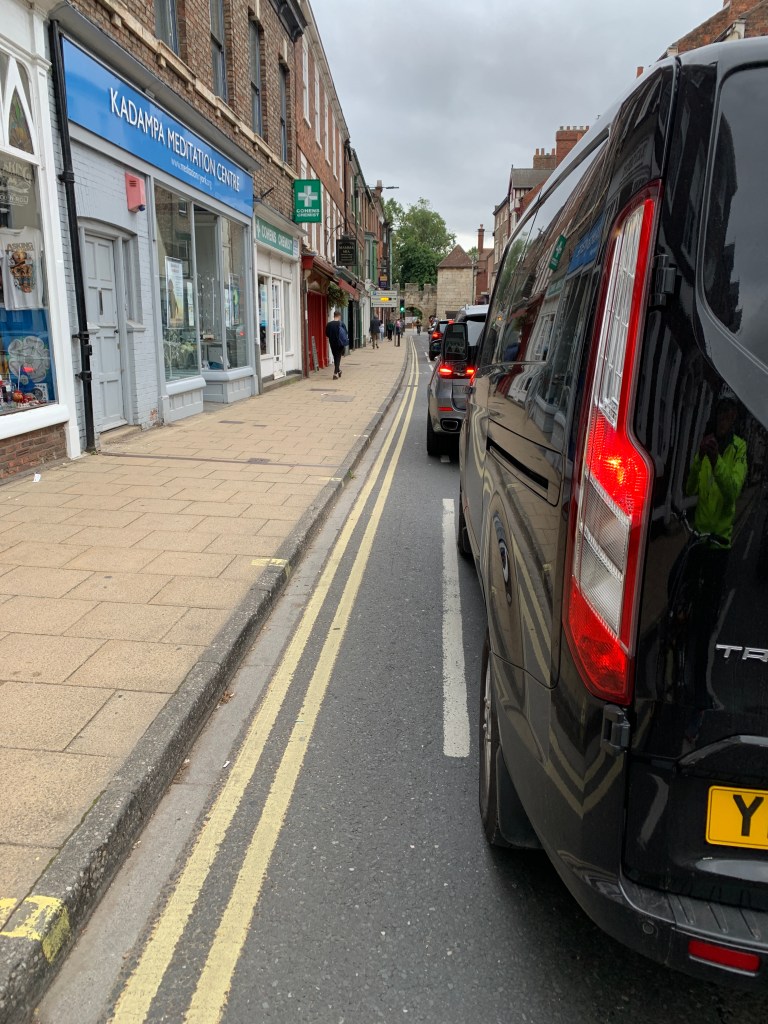
Gillygate – traffic on a normal day

Gillygate Air Quality meeting 25/07/2023

I attended this meeting with Ian McNabb and Rich Hearn. We joined residents from Gillygate, Lord Mayors Walk (LMW), Portland Street and business owners from Gillygate Guest House and Love Cheese. Two representative from York Civic Trust also attended. The meeting was led by Brendan Hopkins who has lived in Gillygate House for the last 2 years. (Brendan is a company chairman with links to property, media and horse racing)

From the council side the meeting was hosted by Cllr. Peter Kilbane.(Dep Leader) Cllrs. Kate Ravillious (Env and Climate Emergency), Tony Clarke (Guildhall Ward) and Rachel Melly (Guildhall Ward) also attended. Council staff included James Gilchrist, Director of Environment, Transport and Planning, and other officers.

The session began with Brendan Hopkins outlining the problems. Air Quality worst in Yorkshire, diesel bus emissions (retrofitting engines to reduce emissions not working), stationary traffic, phasing of lights, properties having to keep windows closed, evidence of black dust on window ledges and steps, size of lorries on the street, health hazards etc. He suggested measures including stopping diesel bus access and introducing more electric buses, removing Gillygate from SatNav maps, reducing traffic flows, a campaign to persuade motorists to switch off engines whilst idling in traffic queues and looking at the phasing of traffic lights.

This was followed by anecdotal accounts from all attendees. Health issues, tasting pollution on the doorstep, children at risk from car fumes (they are much closer to exhaust pipe emissions that adults and far more vulnerable). Elderly people advised not to leave their homes at peak traffic times. Accounts of how much traffic and congestion had increased over the last 20 years. A drawing by Rich Hearn’s 8 year old son, Seth, (No11) expressing his view of the problem and action that could be taken was circulated to much approval in the room. Rich made a well researched and passionate contribution to the meeting.

The YCT people referred to their report about the problems presented by Gillygate’s traffic. (Some of us were involved in the original presentation of that report at a photoshoot in Exhibition Square some time ago) Their report suggests reducing traffic in Gillygate through a number of well researched measures, including a ‘bus gate’ (a section of Gillygate being accessible only to buses at certain times of day), no left turn from Bootham to Gillygate and LMW to Gillygate to divert traffic away.

The councillors responded by looking forward to their Local Traffic Plan, which the previous adminstration had failed to deliver to deadline 2 years ago. They said they aimed to have a draft ready for a meeting in October. If approved there would a public consultation with the earliest final approval by Spring of 2024. The implementation of that plan would of course follow over a period of time so that legal and financial plans could be put in place.

It was also disclosed that the phasing of the traffic lights on Gillygate had been changed. It was originally set to control the volume of traffic allowed into Gillygate but had been altered at some point so that it no longer fulfils that function. James Gilchrist promised to look at the phasing again to see if it could again reduce the traffic flow to limit the number of stationary vehicles in the street. Inevitably it would mean traffic would have to be held elsewhere increasing pollution in those areas – e.g. Bootham, LMW and Clarence Street. We were also told of new regulations from central government that will allow drivers who stop in a yellow box junction (as at Bootham and LMW) to be prosecuted using camera evidence. At present only the police can enforce the yellow box rules and rarely do, if ever. That may also reduce congestion.

Buses. A request was made for negotiations between the council and bus operators to use different routes and/or increase the use of electric buses. The council said there was limited scope for enforcing change on bus operators as they were independent providers of bus services. We were told that Gillygate is in a Low Emision Zone and buses have to comply with low emission zone rules although open top buses are exempt from that legislation. Enforcement is difficult and it was largely felt that some, possibly many, vehicles do not meet the low emission standards.

We discovered government limits for NO2 in the air have not been revised since the World Health Organisation suggested cutting them by half. This means that Gillygate is more than 41/2 times the healthy limit, which all agreed is unacceptable. Further to those figures there are other gases and particulates that exceed healthy limits.

James Gilchrist didn’t think it was possible to remove Gillygate from SatNav routes. The systems are driven by algorithms which analyse traffic flows and base their suggested routes on those behaviours. This was challenged with anecdotes from other parts of the world.

So is there any immediate action apart from waiting for the above suggestions? The challenge was thrown open to us. Could we produce signs for display locally that encourage drivers to switch off their engines whilst queuing  – perhaps based on Seth’s drawings? An appeal to protect our children rather than an order to beat drivers over the head with legislation that no one can enforce? Something for residents and others to take up.

I felt the meeting was positive, with a good reception from officers and councillors. There is inevitable frustration things can’t be changed faster but there was a commitment to change – only time will tell how much is implemented. There was some suggestion of civil action if change is delayed. York Civic Trust and some residents asked for a monthly meeting with council representatives to monitor progress and to offer further feedback. This was agreed by Cllr Kilbane.

We’ll keep you posted.

Subsequently the Councillors have issued a story apparently as a result of our meeting.

Electric vehicles aren’t the answer for cleaner air in York, says climate boss

Top 10 green living myths | Duncan Clark |

Carbon footprint

A closer look at some of the commandments of green living could greatly reduce your carbon footprint. Photograph: Getty

1. What they tell you: Turning off the lights saves CO2

What they don’t tell you: It makes sense for individuals to use less electricity to help reduce the emissions of British power stations. However, it’s worth bearing in mind that the total amount of CO2 that can be released by power plants and other industrial facilities across the EU between now and 2012 is fixed by the European Emissions Trading Scheme. This means that if the UK power sector reduces its emissions, extra carbon permits get freed up for use elsewhere, such as German power stations or French cement plants. In other words, the same amount of CO2 will be released, just from different sources. If you want to ensure that your electricity savings do make a real environmental difference, join Sandbag, a charity that will remove CO2 permits from the EU scheme to stop your good work being traded away on the carbon markets.

2. What they tell you: Buy a greener car

What they don’t tell you: If you definitely need a new car, it makes perfect sense to buy a small, super-efficient model with low CO2 emissions. However, making a new car ??? including mining and processing the metals and manufacturing and assembling the components ??? takes a huge amount of energy. According to an expert at the Stockholm Environment Institute, the production of a typical modern car causes around 8 tonnes of CO2, equivalent to driving 23,000 miles. Because of this, unless you currently drive a lot in a highly inefficient car, it will often be greener to stick to your existing vehicle than to sell it and buy a new one.

3. What they tell you: Going veggie cuts emissions

What they don’t tell you: It’s true that animal products tend to have much higher carbon footprint than food produced from plants. Hence vegetarianism tends to be a good idea from an environmental point of view. The devil is in the detail, however, because certain dairy products are more “carbon intensive” than some meats. In particular hard cheese, which takes a lot of milk to produce, can have a bigger footprint per kilo than chicken. So while cutting out meat ??? especially beef and lamb ??? definitely makes ecological sense, the benefit will be reduced if you make up the calories by consuming more dairy. The most effective way to reduce the emissions of your diet is to go vegan ??? or as close as you can get.

4. What they tell you: Don’t overfill the kettle

What they don’t tell you: It’s not just how much water you boil that determines the carbon footprint of your tea or coffee, but also the type of kettle you use. Jug kettles are fast and convenient, but their fuel ??? electricity from the national grid ??? produces almost three times more greenhouse gas for each unit of heat than burning gas in the home does. Hence switching to a stove-top kettle on a gas cooker will usually reduce emissions ??? especially in colder months when any heat from the flames that escapes around the side of the kettle will warm the room, reducing the burden on the central heating system.

5. What they tell you: Use more efficient appliances

What they don’t tell you: Choosing highly energy-efficient appliances is one good way to ensure that routine tasks such as dishwashing and laundry don’t create more carbon pollution than necessary. But there are other ways, too, such as simply running your machines at night. In the daytime, when electricity consumption is at its highest, the dirtiest, least efficient power stations are rolled out to help meet peak demand. At night, when demand is lower, these power stations can be switched off, which means that each unit of electricity has a lower carbon footprint. Turning your washing machine and dishwasher on before you go to bed therefore shaves a little off your carbon footprint by “spreading the load” on the electricity grid ??? though the difference isn’t as huge as some websites have claimed.

6. What they tell you: Sign up with us, we provide 100% renewable electricity

What they don’t tell you: Various electricity companies promise to provide customers with power from renewable sources. This gives the impression that by signing up you’ll be increasing the amount of clean electricity being produced. The truth is rather more complex. The government requires a certain proportion of UK electricity to come from renewable sources. If an electricity company exceeds this target by generating most or all of its power from renewables it can sell its extra green electricity credits to other companies which in turn can avoid producing any green power themselves. The net effect is that not very much changes. That’s not to say don’t sign up, but if you do use a green power supplier don’t expect your electricity to suddenly be carbon-neutral, no matter what the adverts suggest.

7. What they tell you: Wood fires are green

What they don’t tell you: If you burn the wood in an open fire, the majority of the energy in the wood will be lost up the chimney. Assuming it comes from properly managed forests, however, wood is a green fuel because the CO2 released when it gets burned will be sucked from the air by the trees planted to replace the felled ones. The inefficient burning typical in a fireplace also creates plenty of soot. Like CO2, soot warms the atmosphere by absorbing heat from the sun ??? and it can also travel thousands of miles to settle on Arctic ice, where it accelerates melting by darkening the surface. A much better option environmentally is a log-burning stove. These capture most of the heat from the fuel, greatly reducing the amount of wood required, and they slash soot emissions too. Some modern stoves are so clean-burning that they can even be used in smoke-free zones.

8. What they tell you: Use eco detergents

What they don’t tell you: “Ecological” washing up liquids and clothes detergents offer an environmental benefit by favouring rapidly biodegradable, low-toxicity, plant-based ingredients over harsher synthetic ones. However, when it comes to climate change, most of the footprint of washing up or cleaning clothes is not caused by producing the detergent but by heating the water. Hence the most effective way to cut emissions is simply to be sparing with hot water when washing up and to use low temperature cycles for laundry. If you find a 30-degree wash sufficient with an ecological powder, then that’s ideal; if not, then arguably it would be better to use a more powerful detergent rather than turn up the temperature dial.

9. What they tell you: Reusable nappies are better for the planet

What they don’t tell you: It’s true that disposable nappies occupy a lot of space in landfill sites and consume a fairly large amount of oil in their production. However, an in-depth study from the Environment Agency (pdf) found that the total impact on global warming could be slightly higher for washables than for disposables. Washables can have a lower carbon footprint, but only if you have an energy-efficient washing machine, use a 60-degree wash cycle, limit yourself to 24 nappies, and don’t tumble dry or iron them. Nappy washing services have the highest footprint of all.

10. What they tell you: Buy local

What they don’t tell you: The transport of goods accounts for a small but significant proportion of the human impact on the climate. It generally makes environmental sense, therefore, to favour local food and other products. However, it’s not always true that local is best. One study suggested that lamb from New Zealand, with its clean energy and rich pastures, has a lower footprint when consumed in the UK than locally produced lamb, despite the long-distance shipping. Another study showed that cut flowers sold in Britain that had been grown in distant but sunny Kenya had a smaller carbon footprint than those grown in heated greenhouses in Holland. So while transport is important, it’s not the only factor to consider.

??? The examples above are all drawn from the Rough Guide to Green Living, which was published this month.

I’m a luke warm (for the sake of the environment you understand) green campaigner. I hope these myth busters don’t put you off doing “your bit” but make you wiser in the way you do it.

The Age of Stupid

Last night I watched The Age of Stupid. Set in the future it has everyone living in the present firmly in its sights. The premise is that we are the only people who can turn the environmental tide and there’s not much time left to do it. Generations before us either didn’t know or act and it will be too late for our children to do it. My grandchildren could face a bleak future if we ignore these warnings.
As I looked at my daily prayer plan this morning I realised that The Earth didn’t feature – anywhere. As a believer in prayer and “doing my bit for the environment” I was surprised with myself for this omission.
To me, prayer is about being willing to work together with God and others to bring answers and solutions to problems. It’s when I align myself with what I believe is God’s purpose that I can then both trust and act.
If you have the chance – perhaps I could urge you to make the opportunity – watch this film and then act in whatever way you find possible.
We (the inhabitants of Earth) have to change things – doing nothing is not an option.